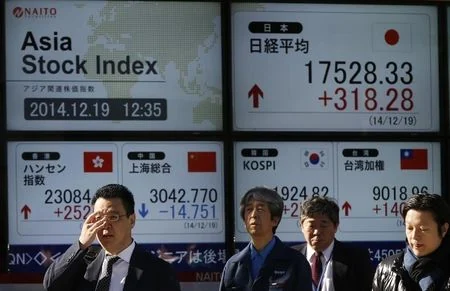
Most Asian stocks rose on Thursday as technology shares recovered and sentiment improved around U.S. trade policy, according to Investing.com. The report says markets regained some footing after a volatile November, though concerns over Nvidia's governance continued to weigh on confidence.
Taiwan's Weighted Index gained 2.6%. South Korea's KOSPI advanced 1.6% and Japan's Nikkei 225 rose 1.7%. Hong Kong's Hang Seng climbed 1.9%. MSCI's Asia-Pacific equity gauge gained 1.3% after an eight-session losing streak had brought it close to bear-market territory.
Nvidia remained a source of uncertainty. S&P Global Ratings placed the company's AA credit rating on CreditWatch Negative, citing concerns over board independence and management oversight, the report says.
On Wall Street, the S&P 500 closed 0.3% lower on Wednesday and the Nasdaq Composite lost 0.6%. The Nasdaq 100 briefly approached bear-market territory before buyers pared its losses, the report says.
The report says Washington proposed new duties on imports from 14 trading partners, including China, Japan, South Korea, Taiwan, India and the European Union. The new tariffs are not expected to be added to duties imposed in July and are unlikely to take effect before February or March.
The Bank of Korea raised its benchmark rate by 25 basis points to 3.25%, the highest since October 2024, after a three-month pause. It upgraded its 2027 growth forecast to 4.1% and its 2026 projection to 3.9%.
U.S. inflation data reinforced concerns about further monetary tightening, the report says. Headline PCE inflation reached 3.8% annually, and core PCE rose 3.3% annually. Markets priced in a 98% probability of a 25-basis-point Fed rate increase in December.
DBS Bank rates strategist Samuel Tse said in a note that weaker growth momentum could support longer-dated U.S. government bonds through safe-haven demand.
Brent crude held near $94.83 a barrel and WTI traded around $84.10, after attacks claimed by Yemen's Houthis on Saudi Arabia's largest oil refinery raised concerns about Middle Eastern supply disruptions, the report says.