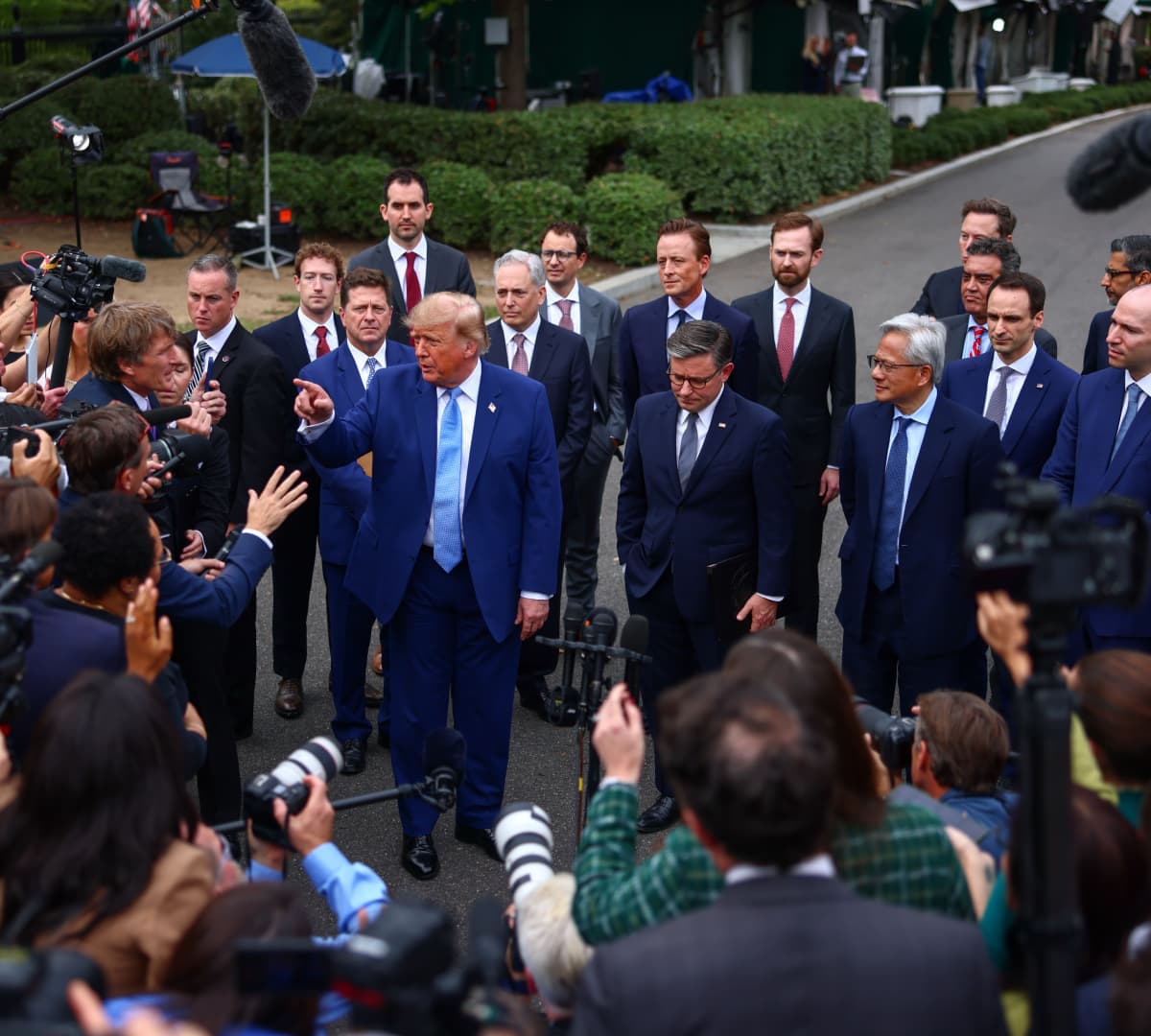
Trump urged the reinstatement of Nvidia CEO Jensen Huang, and the move drew criticism from strategists in both parties, according to CNBC. The report says the Monday reinstatement came at Trump's urging.
Sacha Haworth, founder and CEO of The Tech Oversight Project, said the episode "only reinforces what Americans already believe about a broken political system that stands up for Big Tech CEOs and not the American people."
Brendan Steinhauser, a GOP strategist and CEO of The Alliance for Secure AI Action, said voters "don't trust big tech" and that the episode is "not helpful to Republicans in Congress." Brittany Martinez, executive director of Principles First, said, "Voters are tired of 'rules for thee, but not for me.'"
The report cites a Pew Research Center survey published in October that found 44% of voters considered AI very important to their vote. It also cites an NBC News exit poll finding that 56% of voters said AI and data centers were crucial or a major factor in their vote for Congress.
The report says Huang has faced criticism over a series of extramarital affairs, including one with a suspected Chinese spy. Critics say that could have jeopardized national security, according to the report. Trump told CNBC he assured the board that Huang posed no national security threat. He said, "The bigger threat would be losing the brain power of somebody like Jensen."
Haworth raised concerns that Huang's access to Trump could benefit Nvidia's business interests, especially as the U.S. investigates chip smuggling into China. The report also says Commerce Secretary Howard Lutnick's family has financial ties to Nvidia through Cantor Fitzgerald, a firm his sons now run, and that these ties have drawn congressional scrutiny.
Rep. Suzan DelBene, D-Wash., chair of the Democratic Congressional Campaign Committee, said, "Corruption is an affordability issue."
Sarah Kreps, a political scientist at Cornell University, said the reinstatement looks like "a calculated risk" that benefits from a stable, rising market. The Nasdaq has gained nearly 21% since Jan. 17, 2025, through Tuesday's close, the report says.